The Graceful Home: Designing Beautiful Spaces Built for Real Life

Photo: Marines from Arlington, VA, United States, Public domain, via Wikimedia Commons
There is a particular kind of exhaustion that comes from living inside a beautiful room you are afraid to use. The pale linen sofa that cannot survive a dinner party. The white oak floor that shows every footprint. The open shelving that requires weekly styling to avoid looking chaotic. These spaces photograph magnificently. They are considerably harder to inhabit.
For too long, a certain strain of interior design culture — amplified by social media and the perpetual scroll of aspirational imagery — has quietly suggested that the price of a beautiful home is constant vigilance. That elegance and ease are, by nature, incompatible. This is a myth, and it is one worth dismantling deliberately.
Beauty That Doesn't Hold Its Breath
The most enduring interiors in design history — the worn stone floors of Provençal farmhouses, the richly patinated leather of a well-used library chair, the aged brass hardware of a century-old kitchen — share a quality that modern design culture frequently overlooks: they improve with time. They absorb life rather than resist it. Their beauty is not contingent on perfection.
This quality has a name in Japanese aesthetics — wabi-sabi — but it is equally present in the American tradition of honest materials and unpretentious craftsmanship. A rough-hewn oak dining table that develops character through decades of family meals is not a compromise. It is a design achievement. The question worth asking, then, is not how to protect a space from life, but how to design a space that welcomes it.
Rethinking Materials from the Ground Up
The most consequential decisions in any interior are material ones, and they are also among the most misunderstood. Homeowners frequently select finishes based on how they appear in a showroom under controlled conditions, then discover — too late — how those materials perform under the actual conditions of daily existence.
Hardwood flooring in lighter stains, for instance, tends to show dust, pet hair, and scuff marks with unforgiving clarity. Medium-toned woods with natural variation — think white oak with a matte finish, or wire-brushed walnut — are far more forgiving, absorbing minor wear into their visual character rather than broadcasting it. Textured surfaces, whether in wood, stone, or tile, outperform smooth ones in high-traffic areas for precisely this reason.
Upholstery presents a similar calculus. Performance fabrics — those woven with solution-dyed acrylic or treated with stain-resistant technology — have advanced to the point where they are genuinely difficult to distinguish from their more delicate counterparts. A performance velvet or a tightly woven boucle can anchor a living room with sophistication while enduring the realities of children, pets, and the occasional wine glass placed without a coaster.
Natural stone countertops, beloved for their organic beauty, vary enormously in porosity and durability. Quartzite and soapstone offer the visual warmth of marble with considerably greater resistance to etching and staining. For homeowners committed to marble's particular aesthetic, honed finishes — matte rather than polished — conceal scratches and watermarks far more effectively than their high-gloss counterparts.
The Layout Imperative
Materials matter enormously, but layout is equally decisive in determining whether a space functions gracefully under pressure. Many of the maintenance burdens Americans associate with beautiful homes are, in truth, the consequence of layouts that work against natural behavior.
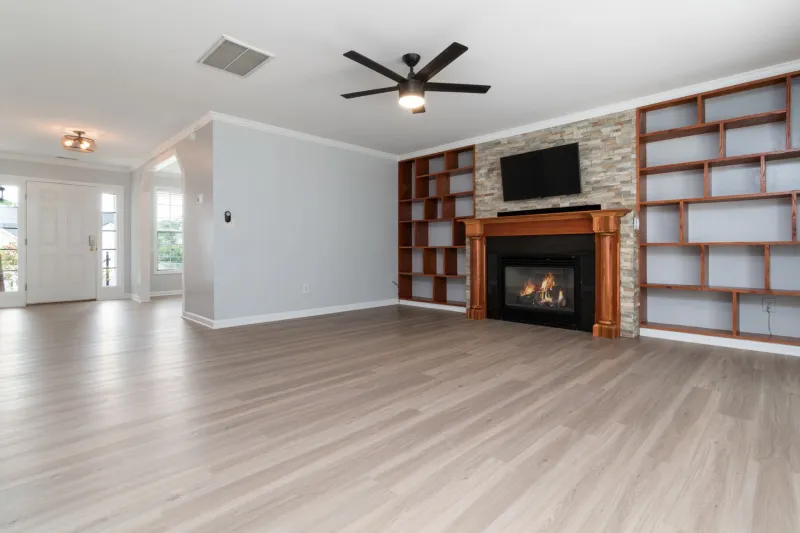
Open shelving, for example, can be genuinely stunning — and genuinely demanding. The solution is not necessarily to abandon it, but to be selective about where it is deployed. Open shelving in a living room, displaying books and curated objects, requires far less daily management than open shelving in a kitchen, where cooking activity introduces grease, steam, and the constant displacement of items. Understanding where clutter naturally accumulates, and designing storage solutions that intercept it before it becomes visible, is one of the most practical contributions a skilled designer can offer.
Similarly, entryways — the first and last spaces encountered in any home — deserve particular attention to functional design. A beautiful entry that lacks hooks, a bench, a place for bags and shoes, and some form of concealed storage will always look chaotic, regardless of how thoughtfully it is decorated. Building function into the architecture of a space, rather than layering it on afterward, is the difference between a room that maintains itself and one that demands constant intervention.
Embracing the Aesthetic of Durability
There is a growing segment of American homeowners — design-literate, experience-oriented, and increasingly skeptical of the disposable aesthetic — who are actively seeking out spaces that feel genuinely lived in. Not staged. Not curated to within an inch of their lives. Lived in, in the fullest sense: warm, layered, and honest about their purpose.
This appetite is reshaping what sophisticated design looks like in 2024 and beyond. Reclaimed materials, patinated metals, linen that wrinkles beautifully, concrete that develops a subtle sheen over time — these are no longer the province of industrial lofts or rustic retreats. They are appearing in high-end urban apartments and suburban family homes alike, chosen not despite their imperfections but because of them.
At Decor Design Studio, we have observed this shift firsthand. Clients who once arrived with inspiration boards dominated by pristine white interiors are increasingly drawn to spaces with texture, depth, and what one might call biographical quality — the sense that a room has been inhabited by people who actually enjoy being in it.
The Myth of the Maintenance-Free Home
To be clear: no home is entirely maintenance-free, nor should it be. Care and attention are part of how people develop a relationship with the spaces they inhabit. The goal is not to eliminate upkeep but to calibrate it — to ensure that the care a space requires is proportionate to the life being lived within it.
A home occupied by a family with young children and two dogs requires a fundamentally different material and layout strategy than a home shared by two adults with a weekly cleaning service. Neither is more or less worthy of beauty. Both deserve interiors that support rather than undermine the lives being led inside them.
The most sophisticated question a designer can ask — and one that every homeowner should be asked — is not "What do you want this space to look like?" but rather "What do you want this space to allow you to do?" The answer to that second question is what separates a beautiful photograph from a beautiful life.
Designing With Honesty
The homes that endure, that remain beloved and functional across decades rather than seasons, are the ones designed with honesty about how people actually live. They are not perfect. They are not pristine. They age, accumulate, and evolve. And in doing so, they become something no showroom can replicate: genuinely, unmistakably inhabited.
That quality — the grace of a space that has absorbed real life without losing its beauty — is the standard worth pursuing. It requires more thoughtful design at the outset, not less. But it rewards that investment every single day, without demanding perfection in return.