The Invisible Room: How Intentional Fragrance Design Completes a Space
There is a particular kind of home that stays with you. Not because its furnishings were exceptional or its palette especially refined, but because something about it settled into your memory in a way that purely visual spaces rarely do. More often than not, that lingering impression was carried by scent. A faint trace of cedar, a whisper of white tea, the green coolness of a living wall near the entry — these invisible details are not accidents. They are, in the most considered homes, deliberate design choices.
At Decor Design Studio, we regard fragrance as an architectural element in its own right. It occupies no square footage, requires no structural modification, and yet it shapes the experience of a space with a precision that surprises even seasoned designers. Understanding how to deploy it thoughtfully is among the most sophisticated skills in the modern interior design toolkit.
Why Scent Works the Way It Does
The relationship between smell and emotion is not a matter of preference — it is neurological. The olfactory system connects directly to the limbic region of the brain, the area responsible for memory formation and emotional response. Unlike sight or sound, scent bypasses the analytical layers of cognition and lands immediately in feeling. This is why a single note — damp stone, warm vanilla, crushed eucalyptus — can transport a person to a specific moment decades in the past within seconds.
For designers, this neurological directness is enormously useful. A fragrance introduced into a space does not merely add pleasantness; it conditions how that space is emotionally received. It can make a room feel more expansive or more intimate, more energizing or more restorative, more personally resonant or more universally welcoming. When chosen with care, it becomes the emotional subtext of a room's entire design story.
Mapping Fragrance to Function
The first principle of intentional fragrance design is alignment — matching the scent profile of a room to its intended purpose and atmosphere. This is not simply a matter of placing a candle on a shelf. It requires the same spatial thinking applied to light levels or traffic flow.
In a primary bedroom designed for deep rest, fragrance should support the body's transition toward sleep. Lavender remains a classic for good reason, but it need not be deployed in its most obvious form. A linen spray with lavender and warm sandalwood base notes, used sparingly on bedding, creates an olfactory cue that communicates rest without announcing itself. Cedarwood diffused at low intensity through a quiet corner of the room adds depth and a grounding quality that cooler florals cannot provide.
In a home office or study, the calculus shifts entirely. Here, clarity and focus are the design objectives. Citrus families — bergamot, grapefruit, yuzu — are well-documented for their ability to support alertness without agitation. Pairing them with a clean herbal note such as rosemary or peppermint creates a fragrance environment that feels purposeful rather than indulgent, appropriate to a space where concentration is the priority.
Living rooms and gathering spaces present a more nuanced challenge. These rooms must welcome a range of moods and accommodate multiple occupants with different sensory sensitivities. In this context, restraint is a virtue. A lightly scented room — perhaps through a single reed diffuser positioned near the entry point of the space, rather than at its center — provides presence without dominance. Warm, universally accessible profiles such as fig, soft amber, or fresh linen tend to perform well in shared spaces, offering comfort without asserting a strong individual identity.
The Art of Fragrance Layering
Just as a well-designed room layers textures, materials, and light sources, a sophisticated fragrance strategy operates across multiple delivery methods simultaneously. Each method has its own character and radius of effect.
Natural botanical elements — fresh-cut stems, potted herbs, living moss walls — provide the most organic and ephemeral layer. Their scent is subtle, alive, and shifts with the seasons. A cluster of eucalyptus hung in a bathroom, a pot of basil near a kitchen window, a bowl of dried lavender on a console table — these introductions feel genuinely inhabited rather than artificially perfumed.
Candles occupy the middle register of this layering system. They offer warmth, both olfactory and visual, and their scent radius is contained and controllable. The quality of the wax and wick matters enormously here; lower-quality paraffin candles often introduce a chemical undertone that undermines the very atmosphere they are meant to create. Soy and beeswax alternatives, particularly those from small-batch American makers, tend to burn cleaner and carry fragrance more faithfully.
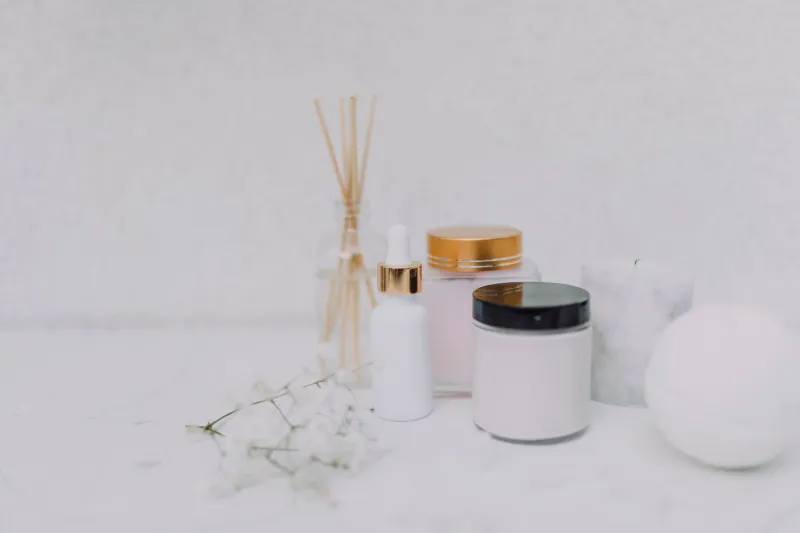
Diffusers — whether ultrasonic, reed, or passive ceramic — provide the most consistent and sustained background presence. They are best deployed in spaces where ambient scent is desired throughout the day, rather than in response to a specific ritual or occasion.
Coherence Across the Home
One of the most common fragrance missteps in residential design is the absence of cohesion. When each room operates as an entirely independent olfactory island — vanilla in the bedroom, heavy incense in the study, a synthetic floral in the bathroom — the home loses its sense of continuity. Moving through the space becomes a series of jarring sensory resets rather than a fluid, unified experience.
A more considered approach establishes a fragrance family or signature that runs as a thread through the home, with room-specific variations rather than complete departures. If the home's primary register is warm and botanical — cedar, vetiver, green leaf — then individual rooms might modulate around that core. The bedroom deepens it with lavender and sandalwood. The kitchen lifts it with citrus and fresh herbs. The entry introduces it cleanly, without complication, so that crossing the threshold begins the experience immediately.
This kind of olfactory continuity is what distinguishes a designed home from a merely decorated one. It signals that every sensory dimension has been considered, not as an afterthought, but as an integral part of the spatial vision.
Personalization and the Signature Scent
Beyond function and cohesion, fragrance offers something that few other design tools can: the capacity for genuine personal signature. A home's scent, when thoughtfully chosen, becomes as identifying as its architectural style or its color palette. It is what guests remember. It is what residents feel when they return after time away.
Developing a home's signature fragrance is a process of curation and refinement. It begins with honesty about the occupants' preferences and sensitivities, moves through experimentation with raw materials and finished products, and arrives — over time — at a profile that feels both distinctive and inevitable. Some clients find their signature in a single extraordinary candle. Others build it from the accumulation of natural elements, textiles treated with a favored linen water, and a diffuser blend developed in collaboration with an artisan perfumer.
At Decor Design Studio, we increasingly treat this process as a natural extension of the broader design consultation — a final layer that seals the experience of a space and makes it unmistakably, memorably its own.