Designed to Shift: The Case for Furniture That Moves, Transforms, and Grows With Your Life
There is a particular kind of furniture that reveals its value slowly. It does not announce itself with dramatic lines or a commanding presence the moment you enter a room. Instead, it earns your admiration over time—through a hinge that folds precisely when you need more floor space, through a shelf configuration that quietly reorganizes itself as your book collection expands, through a storage ottoman that holds your daughter's art supplies this year and your home office overflow the next.
This is the philosophy of adaptive furniture: the conviction that a piece should serve not only who you are today, but who you are becoming.
At Decor Design Studio, we work with homeowners across a wide range of life stages, and one truth surfaces repeatedly in our consultations: the spaces that age most gracefully are not those filled with the most expensive pieces, but those designed with the most intentional flexibility. The distinction matters enormously—and it begins with understanding what adaptability in furniture truly means.
More Than a Trend: The Deeper Logic of Multi-Purpose Design
Flexible furniture is often discussed within the narrow context of small-space living—studio apartments in New York, compact condos in Chicago, urban homes where every square foot must justify itself. While that application is entirely valid, it represents only a fraction of the story.
Adaptive design is, at its core, a philosophy about resilience. When a household expands to welcome a new child, when adult children return home after college, when a spare bedroom must become a productive home office without losing its identity as a guest room—these are moments when rigidly defined furniture fails its owners. The dining table that cannot extend, the shelving unit that cannot reconfigure, the sofa that cannot accommodate an additional seat: these pieces force the room to resist change rather than receive it.
Designers who specialize in long-term residential interiors consistently note that the clients who feel most at home in their spaces five or ten years after the initial design are those whose foundational furniture was chosen with adaptability in mind. The aesthetic vision may evolve; the color palette may shift; but the structural pieces continue to serve because they were never rigidly assigned a single purpose.
The Pieces Worth Prioritizing
Not every item in a room needs to perform multiple functions. In fact, a space composed entirely of transformer-style furniture can feel restless and uncommitted—as though the room has not yet decided what it wants to be. The goal is strategic placement: identifying which pieces, in which positions, carry the greatest potential for meaningful flexibility.
The Expandable Dining Table
Few investments offer as much long-term utility as a dining table engineered to expand. Whether through a butterfly leaf, a draw-leaf mechanism, or removable extensions, this single piece can carry a household through intimate weeknight dinners and large Thanksgiving gatherings without requiring a second table or a separate storage solution. When selected in a material and finish that complements the broader design scheme—a solid white oak, a brushed concrete top, a richly lacquered surface—it becomes an anchor piece that serves both daily life and occasion without compromise.
Modular Shelving Systems
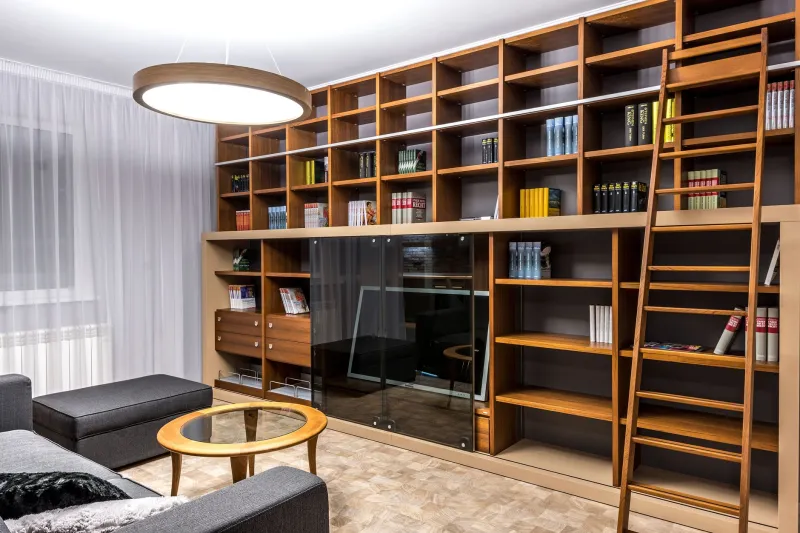
The shelving unit you install in your home office should not be a permanent fixture in the architectural sense. Modular systems—those that allow you to add vertical height, horizontal depth, or specialized compartments over time—function as living infrastructure. They accommodate the moment when your vinyl record collection doubles, when your children's picture books give way to young adult novels, when a dedicated display zone for ceramics or travel objects becomes a design priority. Brands offering modular configurations now produce pieces of genuine aesthetic quality, moving well beyond the flat-pack aesthetic that once defined adjustable shelving.
The Ottoman as Design Anchor
Perhaps no single piece embodies the spirit of adaptive furniture more elegantly than the well-chosen ottoman. As a coffee table, it softens a seating arrangement and introduces texture. As additional seating, it accommodates a gathering without requiring permanent chairs. As concealed storage, it absorbs the visual clutter that accumulates in any lived-in space. When upholstered thoughtfully—in a performance fabric that resists staining, in a neutral that coordinates across evolving color schemes—it becomes one of the most hardworking and quietly beautiful elements in a room.
Convertible and Daybed Sofas
The convertible sofa has undergone a significant design evolution in recent years. Where once the pull-out mechanism was synonymous with an uncomfortable mattress and an awkward frame, today's convertible pieces are engineered with genuine sleeping comfort in mind and styled to read as sophisticated seating during daylight hours. For households maintaining a guest room that doubles as a study or creative space, this single piece resolves the tension between hospitality and daily function with considerable elegance.
The Aesthetic Dimension: Flexibility Without Compromise
One of the most persistent concerns among homeowners considering multi-purpose furniture is the fear of aesthetic sacrifice—the worry that adaptable pieces will look provisional, temporary, or insufficiently refined. This concern, while understandable, reflects an older generation of flexible furniture rather than the current landscape.
The design market has responded to the growing demand for adaptable interiors with pieces that prioritize material quality, proportional integrity, and visual coherence alongside functional range. A nesting table set in hand-rubbed walnut does not announce its utility; it simply delivers it when required. A wall-mounted drop-leaf desk in lacquered white reads as a considered design choice until the moment it becomes a functional workspace.
The key, as with all interior decisions, lies in curation. Selecting flexible pieces that share a coherent design language—a consistent material palette, a unified aesthetic sensibility—ensures that the room feels resolved rather than improvised.
Designing for the Life You Cannot Yet Predict
There is something quietly optimistic about designing a home with adaptability at its center. It acknowledges that life does not hold still—that the family you are today will not be the family you are in five years, that the career you have now may reshape your spatial needs in ways you cannot anticipate, that the home you love at thirty should still feel like yours at fifty.
At Decor Design Studio, we encourage our clients to think of their interiors not as completed compositions but as considered frameworks—spaces designed with enough structural intelligence to absorb change without losing their essential character. The furniture that listens, that bends without breaking, that serves today and tomorrow with equal grace, is not a compromise. It is, in many ways, the highest expression of intentional design.
When you invest in pieces that move with your life rather than against it, you are not simply furnishing a room. You are building a home that is genuinely prepared for everything that home means.