Coming Home to Yourself: Designing an Entry That Resets Your Mind and Restores Your Calm

There is a particular kind of exhaustion that accumulates not in the body but in the mind. It arrives with the commute, the inbox, the relentless negotiation of public life. And unless something interrupts it, that accumulated tension does not stop at your front door—it walks straight through with you, settling into your evening, your dinner table, your sleep.
What if the solution was already standing at the edge of your home, waiting to be designed with greater intention?
The entry—whether it is a proper foyer, a narrow apartment hallway, or a side door off the garage—is one of the most consequential and most neglected spaces in American residential design. It is the first surface your nervous system encounters when you return home. And with the right combination of spatial design and sensory cues, it can function as a genuine neurological reset: a place where the outside world is consciously set down and something quieter is picked up in its place.
The Science of Transitional Spaces
Neuroscientists and environmental psychologists have long understood that physical environments communicate directly with the brain's limbic system—the region governing emotion, memory, and stress response. Transitional spaces, in particular, carry outsized influence because they signal a shift in context. When the brain perceives a meaningful change in environment, it begins recalibrating its internal state accordingly.
This is why certain hotels feel immediately calming the moment you step inside, or why a well-designed spa lobby can begin to lower your heart rate before you've even checked in. These environments are engineered to trigger what researchers call a "context reset"—a neurological cue that the rules, demands, and pressures of the previous environment no longer apply.
Your home entry can be designed to do precisely the same thing. It does not require a grand architectural gesture. What it requires is intentionality: a deliberate arrangement of sensory signals, spatial organization, and small but meaningful rituals that collectively tell your nervous system, you are safe, you are home, you can release.
Sensory Anchors and Why They Work
A sensory anchor is any consistent stimulus—a scent, a texture, a sound, a quality of light—that the brain learns to associate with a particular emotional state. Over time and with repetition, the anchor itself becomes sufficient to evoke that state, much like the way a familiar song can transport you back to a specific moment in your past.
In the context of a home entry, sensory anchors can be woven seamlessly into the design itself. A reed diffuser positioned near the door, chosen for its grounding notes of cedarwood or vetiver, becomes a scent your brain associates with arrival and ease. A specific lamp on a timer, casting warm amber light that activates the moment evening begins, signals the transition from the high-alert frequencies of the workday to something softer. A textured rug beneath your feet—natural jute, a plush wool runner—provides a tactile cue that you are standing somewhere different from where you just were.
None of these elements are decorative accidents. Each one is a considered choice, placed with the understanding that the senses are the fastest pathway to the emotional brain.
The Ritual Architecture of Arrival
Beyond sensory design, there is the matter of ritual—those small, repeated actions that mark the transition from one state to another. Cultures around the world have long understood this instinctively. The Japanese practice of removing shoes at the threshold is not merely hygienic; it is a physical act of leaving the outside world outside. The deliberate pause, the change of footwear, the moment of stillness—these micro-rituals function as embodied punctuation, marking the end of one chapter and the beginning of another.
In American homes, the equivalent rituals are often fragmented or absent entirely. Keys are dropped wherever there is space. Coats are draped over chairs. Bags land on the kitchen counter. The entry is treated as a problem to move through rather than a place to pause within.
Designing for ritual means designing for pause. It means creating a space that gently insists on a moment of stillness rather than rushing you past it.
This might take the form of a well-placed console table with a designated tray—not merely for organizing keys, but as a visual anchor for the act of setting things down. A low bench that invites you to sit, even briefly, as you remove your shoes. A small mirror positioned at eye level, not for vanity but for the quiet act of seeing yourself arrive. A single plant or a simple floral arrangement that introduces the living, breathing quality of the natural world at the very first moment of re-entry.
Designing the Physical Space to Support the Practice
For the entry to function as a restorative threshold, it must be free of the visual noise that signals disorder. Clutter communicates urgency and incompleteness to the brain—precisely the state you are attempting to leave behind. Storage, therefore, is not a practical afterthought but a psychological necessity.
Built-in hooks at a consistent height, a closed cabinet for everyday items, a dedicated charging station tucked from immediate view—these solutions reduce the cognitive load of the space and allow the designed elements to do their work without competition.
Lighting deserves particular attention. Overhead lighting in an entry that is too bright or too cool in temperature mimics the office environments many of us are trying to decompress from. Layered lighting—a table lamp, a wall sconce, perhaps a small pendant—creates depth and warmth that signals evening and rest. Dimmer controls add another layer of intentionality, allowing the light level itself to be adjusted as part of the arrival ritual.
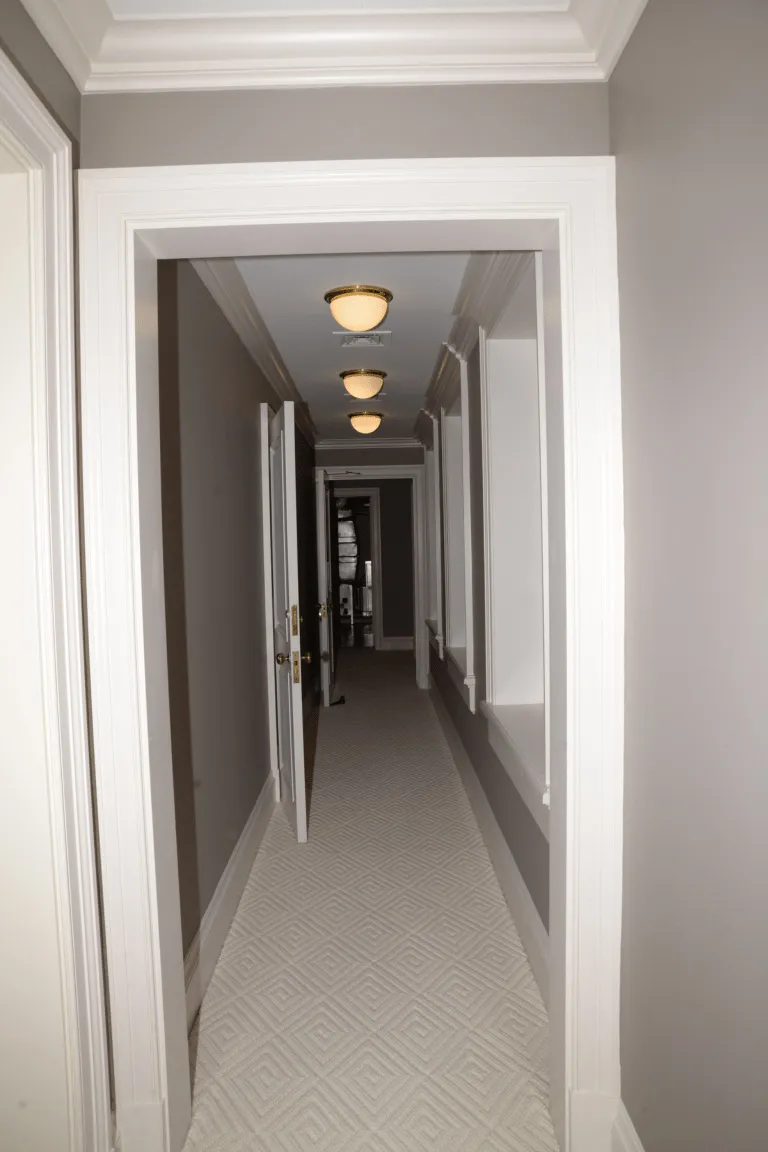
For those working with smaller spaces—a city apartment, a townhouse with a minimal foyer—the principles remain entirely applicable. A single well-chosen piece of art, positioned at the end of a short hallway, gives the eye a place to land and the mind a moment to arrive. A narrow floating shelf serves the dual function of display and organization. Scale adjusts; intention does not.
The Long-Term Return on Intentional Design
The cumulative effect of a thoughtfully designed entry is difficult to quantify but easy to feel. Over weeks and months, the ritual of arriving home in a space that has been designed to receive you begins to reshape the emotional register of your entire household. Stress that once followed you through the door begins to diminish at it. The quality of your evenings improves. The home itself begins to feel more like what it was always meant to be: a refuge, deliberately constructed against the demands of the world outside.
At Decor Design Studio, we approach the entry not as the smallest room in the home but as the most psychologically powerful one. It is the space that sets the tone for everything that follows—and it deserves to be designed with the same depth of thought and care that you bring to every other area of your life.
The threshold is already there. The question is simply what you choose to build around it.