The Private Gallery: Reimagining Your Closet as a Space That Knows You
There is a particular kind of clarity that comes from opening a well-designed closet. Not the frantic clarity of searching through crowded rails or stacked shelves, but something closer to calm recognition — the sense that everything present belongs, and that what belongs has a designated place. For most American households, however, the closet remains the great design afterthought: a space that accumulates rather than curates, that stores rather than serves.
At Decor Design Studio, we believe that no space in a home is too private to deserve intention. In fact, the most private spaces — those seen only by the person who inhabits them — may be the most revealing of all.
Why the Closet Is the Most Honest Room in Your Home
Every other room in a residence is, to some degree, a performance. Living spaces are arranged for guests. Dining rooms are composed for gatherings. Even bedrooms are often styled with a secondary audience in mind. The closet, by contrast, is designed for no one but you.
This absence of external scrutiny makes it both the most neglected and the most telling space in any home. Walk into someone's closet unannounced, and you will understand more about their daily life, their values, and their relationship with their own belongings than an hour of conversation might reveal. The closet does not lie. It holds the evidence of how someone actually lives — not how they wish to be perceived.
Designing this space thoughtfully, then, is not an act of vanity. It is an act of self-knowledge.
The Hidden Cost of Disorganized Storage
Research in environmental psychology has long established a connection between cluttered spaces and elevated cortisol levels — the hormone associated with stress. When applied to the closet specifically, this finding carries meaningful daily consequences. A person who begins each morning navigating disorder, making fragmented decisions among poorly organized options, starts the day already depleted.
Decision fatigue is a well-documented phenomenon: the more choices a person is forced to make, the lower the quality of subsequent decisions becomes. A closet that presents its contents clearly, logically, and beautifully does not merely save time. It conserves cognitive energy that can be redirected toward the day ahead.
Conversely, a closet that reflects genuine personal values — one where materials, proportions, and organization all align with how its owner actually lives — functions almost as a confidence mechanism. The morning ritual becomes less a search and more a selection, less a source of friction and more a moment of quiet self-assurance.
Designing Storage Around Life, Not Around Objects
The most common mistake in closet design is beginning with the objects rather than the person. Standard closet systems — those prefabricated solutions sold in flat boxes at big-box retailers across the country — are engineered for hypothetical wardrobes, not real ones. They assume a particular ratio of hanging space to folding space, a generic number of shoe slots, a one-size approach to drawer depth.
Purpose-built storage begins with an audit of actual life. How does this person get dressed? Do they lay out clothing the night before, or decide in the moment? Do they own primarily casual pieces, professional attire, or an equal mixture of both? Are accessories few and deliberate, or numerous and varied? Is this a person who finds comfort in visual order, or one who prefers concealment?
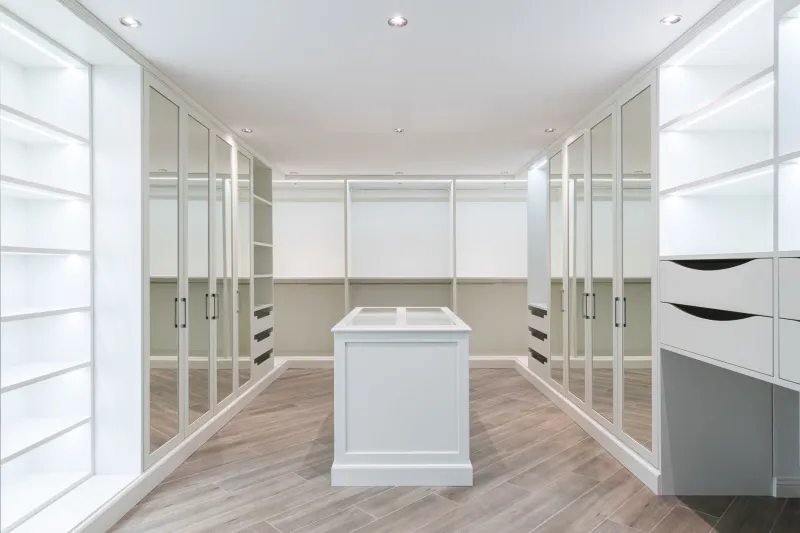
These questions are not trivial. They determine whether open shelving or closed cabinetry is the right choice, whether a central island makes practical sense, whether lighting should be ambient or task-focused, and whether the overall palette should be neutral and recessive or warm and enveloping.
Material Choices as Personal Values
In the same way that material selections in a kitchen communicate something about the values of the household — durability over elegance, or craftsmanship over convenience — the materials chosen for a closet carry their own quiet language.
Natural wood, for instance, brings warmth and a sense of permanence. It suggests an owner who values longevity and tactile quality, who sees storage as something worth investing in rather than tolerating. Lacquered cabinetry in deep, saturated tones reads as decisive and considered — a closet that knows its own aesthetic. Open metal racking, by contrast, speaks to transparency and practicality, a preference for function made visible rather than concealed.
Texture matters as well. Velvet-lined drawers for jewelry and accessories introduce a sensory dimension that elevates the act of selecting something to wear. Matte hardware feels understated and refined. Mirrored panels expand a small space while adding a moment of self-reflection — literally and figuratively — into the morning routine.
The materials you choose for your closet are not merely practical decisions. They are statements about what you believe a private space deserves.
The Spatial Logic of a Well-Planned Closet
Beyond materials and organization, spatial planning itself plays a defining role in how a closet functions and feels. The most beautifully appointed closet will fail if its proportions are poorly considered — if hanging rods are placed too low, if shelves are too deep to see what they hold, if lighting creates shadows precisely where clarity is needed.
At Decor Design Studio, our approach to closet design follows the same spatial principles we apply to every other room: traffic flow, sight lines, proportion, and the relationship between light and surface. A walk-in closet, however compact, should allow for comfortable movement and unobstructed access. A reach-in closet should maximize every inch through vertical zoning, ensuring that the most frequently used items occupy the most accessible positions.
Lighting deserves particular attention. Natural light is ideal where architecture permits it — a skylight above a dressing area transforms the quality of color perception and creates a sense of openness that no artificial source can fully replicate. Where natural light is unavailable, layered artificial lighting — combining ambient ceiling fixtures with targeted task lighting along rods and shelves — ensures that colors read accurately and details remain visible.
Curated Authenticity Beyond What Guests See
There is a particular satisfaction in knowing that the most intentional spaces in your home are the ones no one else will ever see. It signals a relationship with design that is genuinely personal rather than performative — a commitment to quality and thoughtfulness that exists for its own sake, not for the validation of others.
This is what we mean when we speak of curated authenticity. A closet designed to reflect who you actually are — your real wardrobe, your actual routine, your genuine aesthetic preferences — becomes an anchor for the day. It is a space that affirms rather than challenges, that clarifies rather than complicates.
The result extends outward in ways that are difficult to quantify but easy to feel. When the private spaces of a home are as considered as the public ones, the entire residence acquires a different quality of integrity. Nothing is hidden behind a closed door except the evidence of a life well organized.
Designing your closet with purpose is not an indulgence. It is an acknowledgment that you — and the daily rituals that constitute your life — are worth designing for.