What Your Hands Already Know: The Role of Texture and Material in Creating Spaces That Feel as Good as They Look
There is a particular kind of room that photographs beautifully and yet, upon entering, leaves you strangely unmoved. The proportions are correct. The palette is considered. The furniture has been carefully selected. And yet something essential is absent—a quality that no camera can fully capture and no mood board can reliably predict. What is missing, more often than not, is texture.
Texture is the invisible layer of interior design. It operates beneath the threshold of conscious observation, communicating warmth, weight, age, and intimacy before the eye has had time to analyze a single detail. When a space is rich in tactile variety, visitors feel welcomed in ways they cannot always articulate. When texture is absent or monotonous, even the most visually sophisticated room can feel cold, provisional, and somehow unfinished.
Understanding why this happens—and how to address it—is one of the most rewarding disciplines in residential and commercial design.
The Difference Between Seeing and Feeling a Room
Human perception is multisensory by nature. When we enter a space, our nervous systems are processing far more than visual information. The weight of a curtain as it moves in a draft, the slight resistance of a woven rug underfoot, the cool solidity of a marble countertop—these tactile cues register instinctively, shaping our sense of whether a room is safe, generous, refined, or alive.
Design that attends only to the visual dimension produces what might be called flat interiors: rooms that read well in photographs but fail to sustain engagement in person. Flat design is not necessarily bad design. It can be elegant, even impressive. But it rarely feels lived-in, and it almost never invites lingering.
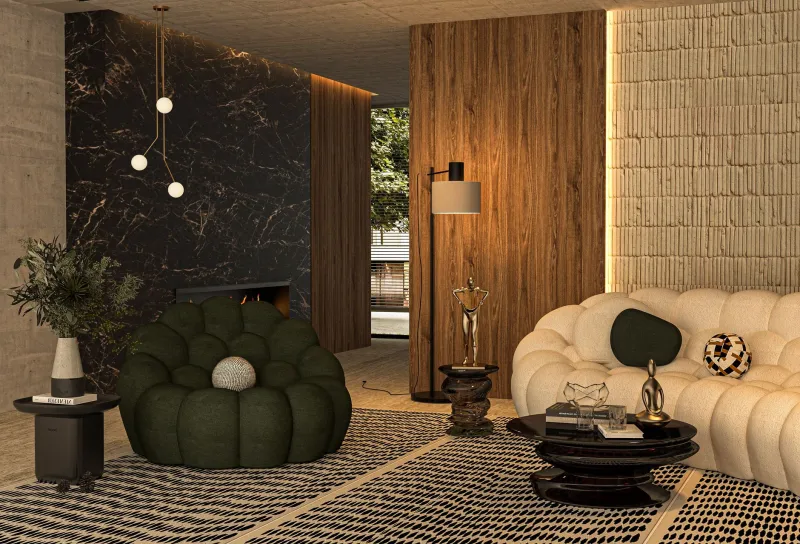
Contrast that with a room where a chunky linen throw rests against a lacquered side table, where a raw-edge oak shelf sits above a plastered wall, where a sheepskin accent meets a geometric tile floor. In such a space, the eye moves continuously, drawn from one surface to another, and the body follows. Touch becomes a form of participation.
Material as Emotional Language
Every material carries a set of associations—cultural, sensory, and psychological—that it brings into a room without announcement. Marble implies permanence and formality. Reclaimed wood suggests history and humility. Polished brass communicates warmth and a certain confident luxury. Raw concrete introduces industrial gravity. Velvet offers softness and a subtle theatricality.
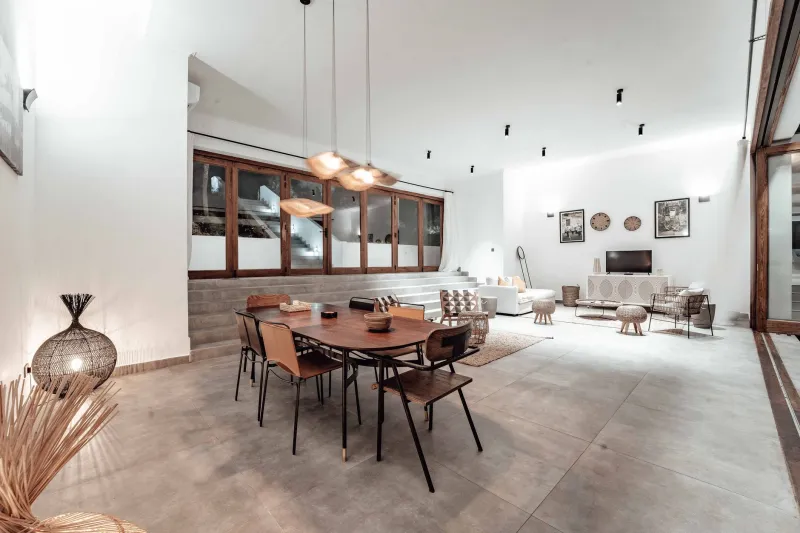
The skill in layering texture lies not in accumulating interesting materials, but in creating deliberate conversations between them. A dining room furnished entirely in smooth, reflective surfaces—glass, lacquer, polished metal—may feel sleek but ultimately sterile. Introduce a matte linen tablecloth, a set of unglazed ceramic vessels, or a rattan pendant overhead, and the dynamic shifts entirely. The room acquires contrast, and contrast produces interest.
At Decor Design Studio, we often describe this process as building a material vocabulary. Just as a well-written sentence benefits from variation in rhythm and register, a well-designed room benefits from surfaces that push against one another in productive tension.
The Art of Unexpected Pairings
Some of the most memorable interiors we have encountered in residential work across the United States share a common characteristic: they contain at least one pairing that should not, by conventional logic, work—and yet does so with quiet authority.
Consider a minimalist living room in which a single piece of rough-hewn stone serves as a coffee table. The surrounding palette is pale, refined, almost austere. The stone is none of those things. It is irregular, heavy, and geological in character. And yet it anchors the room with a kind of primal confidence that no manufactured piece could replicate. The contrast between the polished and the primitive creates a visual and tactile tension that holds the eye.
Or consider a home office where smooth white walls meet a deeply grained walnut desk, a woven jute rug, and a single ceramic lamp with a visibly hand-thrown base. Each element, taken alone, is unremarkable. Together, they produce a room that feels both focused and humanized—a workspace that invites thought without inducing anxiety.
These pairings are not accidental. They are the result of a designer's willingness to move beyond the safety of material uniformity and into the more demanding territory of deliberate contrast.
Layering Texture Across Scales
Texture operates at multiple scales simultaneously, and effective design addresses all of them. At the macro scale, architectural surfaces set the foundational tone: plaster walls, hardwood floors, tile, and paneling establish the primary material register of a room. At the mid scale, furniture upholstery, area rugs, window treatments, and cabinetry introduce secondary layers that either harmonize with or complicate the foundation. At the micro scale, throw pillows, decorative objects, tableware, and small textiles provide the fine-grained detail that rewards close attention.
A common error in residential design is to invest heavily in one scale while neglecting the others. A room with beautiful architectural bones but generic soft furnishings will feel incomplete. Conversely, a room filled with exquisite accessories placed against flat, undifferentiated walls and floors will feel cluttered rather than rich. Balance across scales is what produces the sense of depth that distinguishes a designed space from a merely decorated one.
Texture in Commercial and Hospitality Environments
The principles that govern residential texture design translate directly—and perhaps even more powerfully—into commercial contexts. Boutique hotels, upscale restaurants, and thoughtfully designed retail environments have long understood that tactile richness is a competitive advantage. Guests and customers who feel comfortable in a space stay longer, spend more, and return with greater frequency.
A restaurant that lines its banquettes in aged leather, hangs acoustic panels in undyed wool, and serves food on hand-thrown pottery is making a coherent material argument: that quality extends to every surface a patron encounters. The message is received before a single dish arrives. The space itself has already communicated something worth trusting.
For commercial clients, we approach material selection not only as an aesthetic exercise but as a brand communication strategy. The textures a business chooses to surround its customers with are, in the most literal sense, the first things those customers touch.
Designing for Touch in an Age of Visual Saturation
We live in an era of extraordinary visual abundance. Social media has trained us to evaluate spaces primarily through images—cropped, filtered, and optimized for screen consumption. This has had a measurable effect on interior design, pushing many projects toward photogenic simplicity at the expense of tactile complexity.
The result, in many American homes and commercial spaces, is an aesthetic that performs beautifully online and disappoints in person. Rooms that look polished in photographs but feel hollow when inhabited. Environments that communicate aspiration without delivering comfort.
At Decor Design Studio, we hold a different conviction: that the most successful spaces are the ones that reward presence. They are designed not for the camera but for the person standing inside them—for the hand that trails along a textured wall, the foot that sinks into a generous rug, the eye that moves with pleasure from one considered surface to the next.
Texture, in this sense, is not an aesthetic luxury. It is the design element that makes a space feel real.