Before You Buy a Single Piece: Why Furniture Arrangement Is the Real Design Decision
There is a particular kind of frustration that surfaces after a significant furniture purchase. The sofa is beautiful. The coffee table is exactly right. The rug anchors the color palette with confidence. And yet—something is off. Conversations feel forced. The room doesn't breathe. Guests drift toward the kitchen instead of settling in. The space, despite its carefully selected contents, refuses to function.
The problem, more often than not, has nothing to do with what was purchased. It has everything to do with where those pieces were placed.
Furniture arrangement is not a finishing touch. It is not the step that comes after the real design work is done. It is, in many ways, the design work itself—a spatial and psychological decision that determines how a room communicates, how people inhabit it, and whether it fulfills its intended purpose. At Decor Design Studio, we have observed this truth repeatedly across residential and commercial projects: the most transformative interventions rarely involve a single new purchase. They involve a thoughtful reconsideration of what already exists and where it lives.
The Room Before the Furniture
Every room has an architecture of its own—an invisible grammar composed of doorways, windows, traffic paths, focal points, and proportions. Before any piece of furniture enters the conversation, a designer must read that grammar fluently. Where does natural light fall in the morning? Where does foot traffic naturally want to move? What architectural feature—a fireplace, a bay window, a built-in bookcase—deserves to anchor the room's social center?
Furniture arrangement that ignores this underlying architecture will always feel slightly wrong, even when every individual piece is objectively well-chosen. Placement that honors it, however, creates a sense of ease that most people experience emotionally before they can articulate it intellectually. They simply feel comfortable. They don't know why.
This is the quiet power of deliberate spatial thinking: it operates beneath conscious awareness, shaping behavior and perception in ways that no price tag can replicate.
Proximity and the Social Contract of a Room
One of the most reliable indicators of whether a seating arrangement will encourage genuine conversation is the distance between people. Research in environmental psychology has long suggested that comfortable conversational distance for most Americans falls between four and eight feet. Beyond that range, voices strain, eye contact becomes effortful, and the social momentum of a gathering dissipates.
Yet it is remarkably common to find living rooms where seating is arranged along the perimeter—sofas and chairs pushed against walls, creating a vast, empty center that forces occupants to raise their voices or simply give up. This arrangement may feel instinctively "safe" or space-maximizing, but it functionally discourages the connection the room was presumably designed to support.
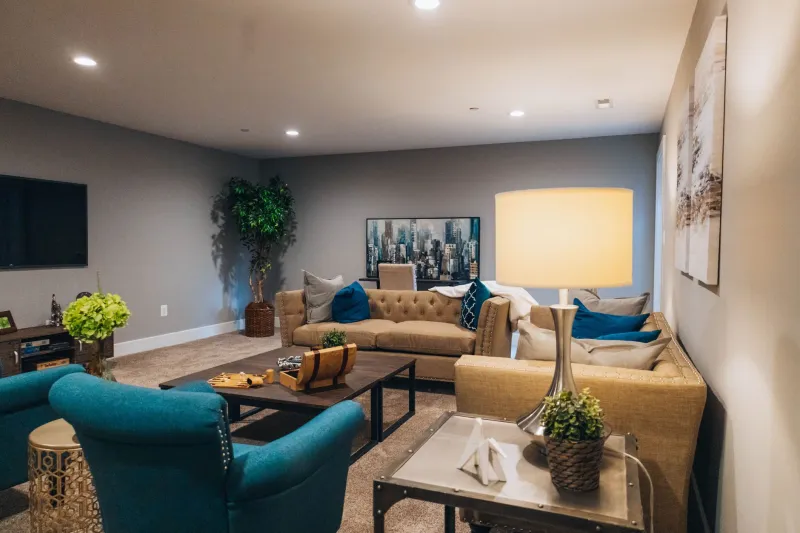
Contrast that with a tighter, more deliberate grouping—two sofas facing each other across a low table, a pair of chairs angled inward at the ends—and the room transforms. It becomes a container for conversation rather than an obstacle to it. The furniture hasn't changed. The square footage hasn't changed. Only the spatial relationships have, and the entire social dynamic of the room shifts accordingly.
Flow as a Design Principle
Beyond the social dimension, furniture arrangement governs something equally important: the experience of moving through a space. Flow—the ease and intuitiveness with which a person navigates from one area to another—is determined almost entirely by placement.
A room with poor flow creates friction. Guests hesitate at the entrance, uncertain where to walk. Paths feel blocked or indirect. The eye doesn't know where to land. Over time, this friction registers as discomfort, even in rooms that are objectively beautiful. People leave sooner. They return less willingly.
A room with considered flow does the opposite. It guides without directing. It offers clear passage while still creating distinct zones—a reading corner here, a conversation cluster there, a transitional moment between the dining area and the living space. Good flow respects the human instinct for legibility: we want to understand a room within moments of entering it, and arrangement is what makes that understanding possible.
In practical terms, this means maintaining clear pathways of at least thirty-six inches between major pieces, ensuring that seating groups have a defined center, and being deliberate about where the eye is drawn upon entry. These are not arbitrary rules. They are responses to the way human beings actually experience and navigate physical space.
The Focal Point as Organizer
Every well-arranged room has an organizing principle—a focal point around which the arrangement coheres. In many American homes, this is a fireplace or a television. In others, it might be a significant piece of art, a dramatic window with a landscape view, or an architectural feature that commands attention.
The mistake many homeowners make is arranging furniture in relation to convenience rather than in relation to this focal point. The sofa ends up facing the window because the wall behind it is the longest. The chairs are positioned wherever they fit. The result is a room that lacks visual hierarchy—a space where everything competes equally for attention and nothing wins.
When arrangement is organized around a clear focal point, the room gains both structure and calm. Every piece understands its role. The eye moves through the space with intention. Even a modest room with budget-conscious furnishings can feel authoritative and composed when its arrangement reflects this kind of spatial intelligence.
Rethinking What You Already Have
Perhaps the most valuable implication of all this is also the most practical: before investing in new furniture, consider whether a rearrangement might accomplish what you're hoping a purchase will.
At Decor Design Studio, some of our most satisfying consultations have involved no new acquisitions whatsoever. A dining table rotated forty-five degrees. A pair of armchairs moved from opposite walls to face each other near a window. A sofa pulled eighteen inches away from the wall to create depth and dimension. These interventions cost nothing beyond time and intention, and their impact on how a space functions and feels can be profound.
This is not an argument against thoughtful purchasing—quality pieces, chosen with care, are genuinely worth investing in. But it is an argument for sequencing. Understand your space. Arrange what you have with deliberateness. Identify what is truly missing before acquiring something new. The room will tell you what it needs, if you are willing to listen to it first.
The Design Decision That Precedes Everything Else
Interior design, at its most purposeful, is not primarily about objects. It is about relationships—between people and space, between pieces and purpose, between the room as it exists and the life it is meant to support. Furniture arrangement is where those relationships are negotiated and resolved.
A beautifully curated room that is poorly arranged will underperform. A simply furnished room that is arranged with intelligence and intention will consistently exceed expectations. The choreography, it turns out, matters more than the cast.
Before the next purchase, before the next refresh, consider the arrangement. Consider the flow, the proximity, the focal point, the conversation it either invites or discourages. The most powerful design intervention available to you may not require spending a dollar. It may simply require seeing the room you already have with fresh, purposeful eyes.