The Bones of a Beautiful Room: Why Baseboards, Crown Molding, and Trim Deserve Your Full Attention
There is a particular kind of disappointment that settles over a room when everything seems right—the furniture is well-chosen, the paint color carefully considered, the lighting thoughtfully layered—and yet something still feels slightly off. Visitors cannot name it. The homeowner senses it but cannot locate the source. More often than not, the answer lies not in what was selected, but in what was ignored: the trim.
Baseboards, crown molding, door casings, window surrounds, chair rails, picture rails—these are the architectural bones of a room. They are the transitions, the punctuation marks, the quiet scaffolding that holds a space's visual logic together. When they are handled with intention, a room achieves a kind of effortless coherence. When they are neglected—or worse, chosen carelessly—they quietly erode every other design decision made around them.
At Decor Design Studio, we have long observed that trim is among the most underestimated variables in interior design. It is time to give it the consideration it has always deserved.
What Trim Actually Does in a Room
Before exploring how to make smart decisions about trim, it is worth understanding what these elements actually accomplish from a design standpoint.
Baseboards serve a functional purpose—they protect walls from scuffs, conceal the gap between flooring and drywall, and provide a visual terminus at floor level. But their design role is equally significant. A tall, deeply profiled baseboard grounds a room, lending it a sense of permanence and architectural weight. A thin, flat baseboard, by contrast, can make a space feel unfinished, as though the room never quite committed to itself.
Crown molding performs the inverse task at the ceiling line. It softens the hard right angle where wall meets ceiling, adding visual depth and—when sized appropriately—a sense of elevated proportion. In rooms with standard eight-foot ceilings, crown molding must be chosen with particular care; too large, and it will compress the space; too small, and it will read as an afterthought.
Door and window casings are perhaps the most visible trim elements in daily life, framing every opening we pass through or look toward. Their profile—whether simple and flat, or layered and classical—sets a tone for the entire room's architectural vocabulary.
The Problem With Treating Trim as an Afterthought
In new construction and renovation projects across the United States, trim is frequently selected from a contractor's standard catalog with minimal deliberation. The logic is understandable: budgets are strained, decisions are numerous, and trim feels like a finishing detail rather than a foundational choice. But this reasoning obscures a critical truth.
Trim is one of the few design elements that touches every surface in a room. It runs along the floor, frames the ceiling, outlines every door and window, and in some cases divides the walls themselves. A poor trim choice does not stay in one corner—it multiplies across the entire perimeter of the space.
Consider a beautifully curated living room furnished with antique-inspired pieces, warm textile layers, and a sophisticated neutral palette. Now imagine that room fitted with the thinnest possible flat-stock baseboard—the kind installed by default in countless American tract homes built over the last three decades. The furniture and textiles will fight an uphill battle against that detail, which signals economy and inattention at every edge of the room.
Conversely, heavy Victorian-era trim profiles can overwhelm a minimalist or Scandinavian-influenced interior, creating a visual dissonance that no amount of styling can fully resolve.
Matching Trim to Architectural Identity
The most reliable principle in trim selection is alignment with the home's existing architectural character. A Craftsman bungalow in California, a Colonial Revival in New England, a mid-century ranch in Texas, and a contemporary loft in Chicago each carry distinct architectural DNA—and the trim in each should honor that lineage.
Craftsman interiors traditionally feature wide, flat-profile casings with simple square or slightly tapered edges, substantial baseboards, and the characteristic built-in elements—bookcases, window seats, plate rails—that make these homes so beloved. Introducing ornate ogee-profile crown molding into such a space would represent a fundamental mismatch of architectural language.
Classical and traditional homes, by contrast, welcome complexity. Layered crown assemblies, fluted pilasters, and deeply profiled baseboards all speak to a formal tradition that rewards detail and craftsmanship. In these environments, restraint in trim can actually read as incompleteness.
Contemporary and transitional spaces occupy a more nuanced middle ground. Here, the goal is typically clean geometry—simple reveals, shadow lines, and minimal ornamentation—executed with precision. In these interiors, the quality of the installation often matters more than the complexity of the profile. A perfectly mitered, seamlessly painted simple casing reads as sophisticated. A poorly installed elaborate profile reads as amateur regardless of its cost.
Color Strategy: When Trim Becomes a Design Statement
For much of the past two decades, painting trim bright white against colored walls has been the dominant convention in American interiors. It is a reliable approach—clean, legible, and broadly appealing. But it is far from the only option, and in many cases, it is not the most interesting one.
Matching trim to wall color in the same finish or a slightly deeper shade creates an enveloping, tonally unified effect that feels distinctly modern and considered. This approach, sometimes called color-drenching, has gained significant traction in design-forward American homes and works particularly well in rooms where the goal is intimacy and depth rather than airy openness.
Alternatively, painting trim in a contrasting dark hue—deep navy, charcoal, or forest green—against lighter walls creates a graphic, almost architectural effect that draws deliberate attention to the room's structural outlines. This is a bold choice, but when executed thoughtfully, it transforms trim from background element into foreground feature.
The key in any color strategy is intentionality. Trim color should be selected in relationship to the walls, the flooring, and the overall tonal direction of the space—not simply defaulted to the nearest white in the paint deck.
Working With What You Have
Not every homeowner is in a position to replace existing trim. Renovation budgets have limits, and a full trim overhaul represents a significant investment in both time and money. But there are meaningful interventions available even when replacement is not on the table.
The single most impactful change in most existing homes is a meticulous repaint. Trim that has been painted multiple times over decades often carries a buildup of drips, brush marks, and uneven texture that reads as neglect. Stripping back to a clean surface and applying a fresh coat of high-quality semi-gloss paint—executed with precision tape lines and a steady hand—can restore trim to a condition that reads as intentional and well-maintained.
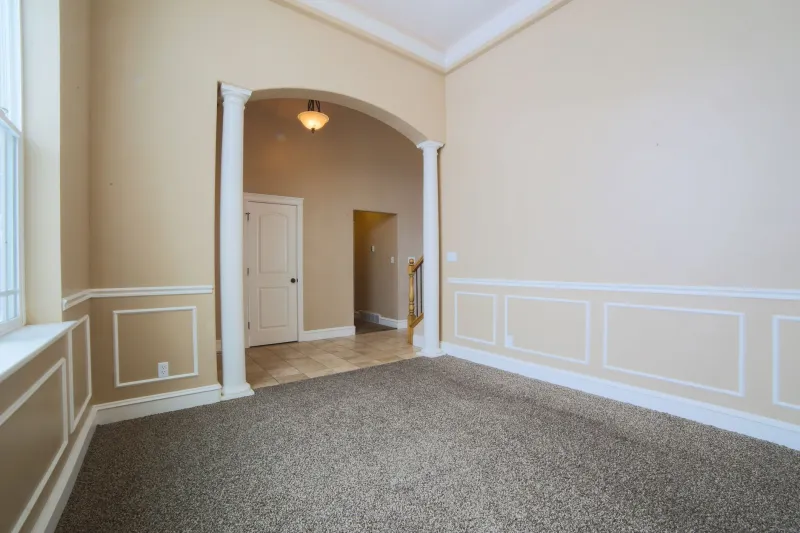
For homeowners seeking more transformation without full replacement, adding trim is a viable strategy. Installing a simple picture rail, adding a band of flat molding to create a paneled effect on lower walls, or layering a simple cove above existing baseboards can meaningfully elevate a room's architectural presence at a fraction of the cost of complete replacement.
The Standard of Finish Matters Enormously
Perhaps the most important principle across all trim decisions is this: execution quality determines outcome more than profile complexity. A simple, well-installed baseboard with tight miters, invisible nail holes, and a flawlessly smooth paint finish will always outperform an elaborate profile installed carelessly.
This is not a minor observation. In our experience consulting on residential interiors across the country, we have seen beautifully specified trim undermined entirely by poor installation—and modest trim elevated significantly by skilled finishing work. When budgeting for trim, allocating resources toward quality installation and finishing is as important as the material selection itself.
The architectural details of a room are not decorative accessories. They are the framework within which everything else operates. Treat them accordingly, and the entire room will respond in kind.