Before You Cross the Door: The Hidden Psychology of Home Entryways
There is a moment — brief, almost imperceptible — that occurs before your hand reaches the door handle. Your pace slows. Your shoulders may drop a fraction of an inch. Your eyes sweep across the familiar facade of your home, and somewhere beneath conscious awareness, your nervous system begins recalibrating. This is the threshold effect, and it is one of the most powerful — and most underestimated — forces in residential design.
For all the attention devoted to living rooms, kitchens, and primary suites, the entry sequence remains curiously neglected in most American homes. Yet neuroscience and environmental psychology suggest that the approach to a home, and the act of crossing its threshold, may do more to shape our daily emotional experience than nearly any other spatial encounter we have.
The Brain's Anticipatory Architecture
Long before the front door opens, the brain is already reading its environment. Researchers in environmental neuroscience describe this as anticipatory spatial processing — the way our minds construct emotional expectations based on visual, auditory, and olfactory information gathered during the approach to a space.
What does this mean in practical terms? It means that a cracked pathway edged with overgrown shrubs communicates neglect to the subconscious mind, triggering low-level stress responses even in homeowners who have walked that same path for years. Conversely, a well-proportioned walkway, softened by deliberate plantings and anchored by warm exterior lighting, sends a neurological signal of order, safety, and welcome — before a single interior element has been encountered.
This is not merely aesthetic preference. It is biology. The amygdala, the brain's primary threat-assessment center, responds to environmental dissonance with measurable physiological arousal. A cluttered, poorly lit, or spatially ambiguous entry sequence keeps that arousal elevated, meaning that residents arrive inside their own homes already carrying an invisible burden of low-grade anxiety.
The Three Zones of the Entry Sequence
Thoughtful threshold design recognizes that the entry experience is not a single moment but a sequence — a choreography of spatial transitions that, when designed with intention, functions as a genuine decompression ritual.
The Approach Zone encompasses everything from the street or driveway to the front door itself. Here, the design vocabulary of materiality, scale, and rhythm matters enormously. A path that narrows slightly as it nears the door creates a subconscious sense of arrival and focus. Textural shifts — from concrete to brick pavers, for example — engage the body's proprioceptive system, signaling that a transition is underway. Mature plantings that frame the facade without obscuring it offer what landscape psychologists call a "prospect and refuge" experience: the sense of being gently enclosed while maintaining clear sightlines.
The Threshold Moment is the act of crossing from outside to inside. This is where architecture earns its keep. Door height and width communicate status and welcome in ways that operate entirely beneath rational thought — a door that is generously proportioned invites; one that is cramped or awkward creates a micro-moment of physical hesitation that registers as unwelcome. The weight and sound of a well-hung door closing behind you provides what designers sometimes call acoustic closure: a literal and psychological sealing off of the exterior world.
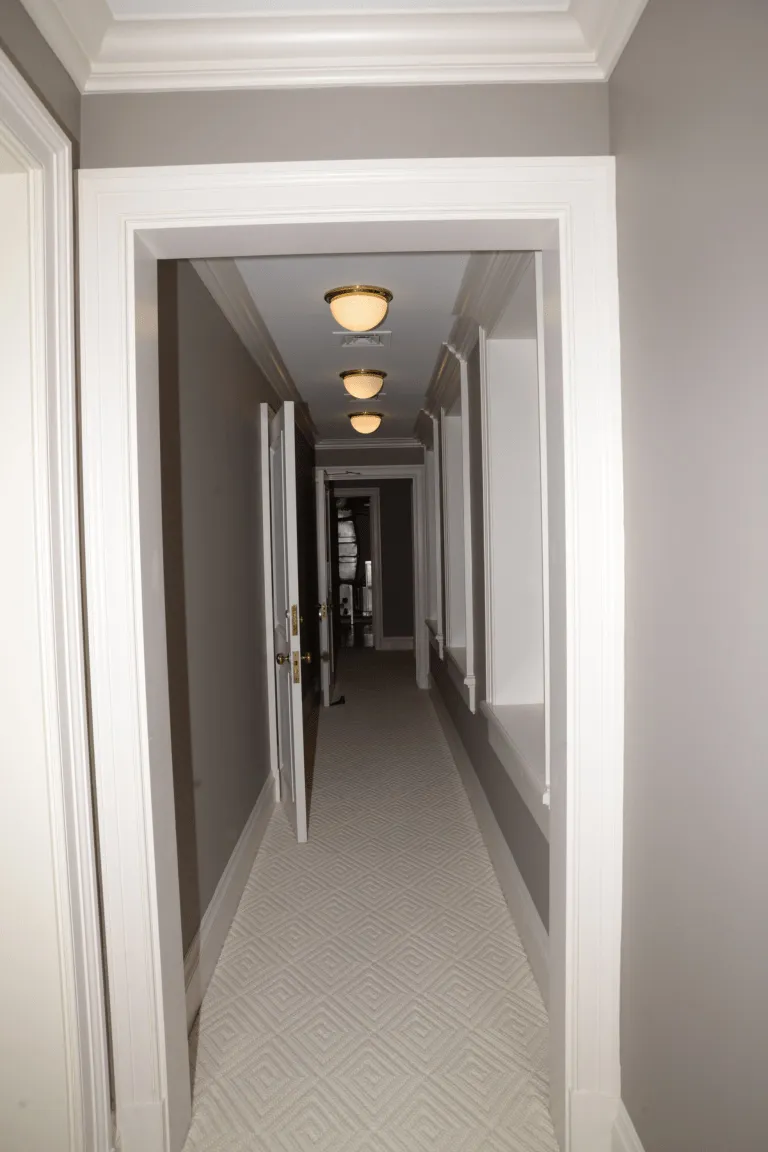
The Decompression Chamber is the interior entry space itself — the foyer, the vestibule, or even a modest landing. This zone serves a critical psychological function: it is neither fully outside nor fully inside, and its design should honor that liminal quality. A space that asks nothing of you — no immediate decision about where to go, no visual chaos demanding attention — allows the nervous system to complete its transition at its own pace.
Sensory Cues That Signal Safety
Beyond spatial sequencing, individual sensory elements carry disproportionate psychological weight at the threshold.
Scent is perhaps the most direct pathway to emotional memory and regulation. The faint fragrance of a candle, fresh flowers, or a diffuser positioned near the entry can serve as a powerful olfactory anchor — a signature that the brain learns to associate with safety, rest, and belonging. This is not a trivial consideration; olfactory signals bypass the rational cortex and connect directly with the limbic system, where emotional memory is stored.
Light quality at the entry deserves particular attention. Harsh overhead lighting in an entry foyer creates an interrogation-room effect — unflattering, disorienting, and physiologically activating. Warm-toned, layered lighting that includes a lower source (a table lamp, a sconce at eye level) mimics the quality of late-afternoon light and triggers the brain's rest-and-restore response far more effectively than a single overhead fixture ever could.
Tactile surfaces encountered immediately upon entry — a textured runner, a smooth stone console, the cool brass of a well-made hook — engage the sense of touch in ways that ground the body in the present moment. This grounding effect is not incidental; it is the sensory equivalent of taking a breath.
Practical Strategies for American Homes
For many US homeowners, the entry sequence presents real spatial constraints. Ranch homes, townhouses, and open-plan properties often lack a dedicated foyer, making the creation of a true decompression zone challenging. The good news is that threshold psychology does not require square footage — it requires intention.
In homes where the front door opens directly into a living area, a partial visual barrier — a console table positioned perpendicular to the entry, a strategically placed bookcase, or even a carefully hung curtain panel — can create the psychological sense of a separate zone without consuming meaningful space. The goal is not physical enclosure but perceptual separation: a signal to the brain that a transition has occurred.
For the exterior approach, even modest interventions yield measurable results. Replacing a single overhead porch fixture with two flanking sconces transforms both the visual symmetry and the light quality of an entry. Lining a walkway with low solar-powered path lights extends the decompression sequence into the evening hours. Introducing a single specimen plant in a well-chosen container beside the door creates what landscape designers call a "sentinel" — a welcoming presence that frames the threshold without imposing upon it.
Finally, consider the ritual potential of your own threshold. The way you approach your home — whether you rush through it or allow yourself a moment of conscious transition — is itself a form of design. Many of our clients at Decor Design Studio find that small physical rituals at the entry, whether pausing to set down a bag, changing footwear, or simply standing still for a breath, amplify the restorative effect of even a simply designed entry space.
Designing the Beginning of Home
The most beautifully appointed interior in the world loses a measure of its power if the journey to reach it is dissonant, cluttered, or emotionally activating. The threshold is not a preamble to the home — it is the home's opening sentence, and like any well-crafted opening, it sets the tone for everything that follows.
When the approach is graceful, the light is warm, and the entry space asks nothing more of you than to arrive, the home becomes something more than a collection of rooms. It becomes a genuine refuge — one that begins working on your behalf before you have even stepped inside.