The Art of Elegant Restraint: Why America's Most Discerning Homeowners Are Choosing Less
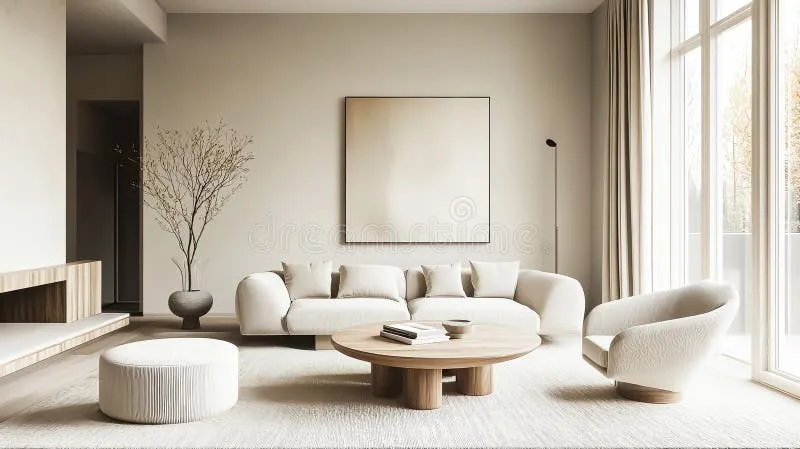
Photo: minimalist luxury living room neutral tones linen furniture natural materials elegant, via thumbs.dreamstime.com
There is a particular kind of confidence required to walk into a beautifully designed room and find it almost unremarkable at first glance. No gallery wall demanding attention. No jewel-toned velvet sofa competing for focus. No shelf styled to photograph well but impossible to actually use. Just a space that feels, almost immediately, like a relief.
This is the experience that a growing number of American homeowners are actively seeking — and that designers across the country are increasingly being asked to deliver. The movement has accumulated several names: quiet luxury, boring beautiful, stealth wealth interiors. But beneath the terminology lies a substantive and culturally significant shift in how we understand the purpose of a well-designed home.
The Cultural Moment That Made Restraint Radical
To understand why understated design feels so resonant in 2024, it helps to consider what came before it. The 2010s were, aesthetically speaking, a decade of assertion. Social media platforms — Instagram in particular — rewarded interiors that read as bold and distinctive in a single photograph. The result was a proliferation of design choices optimized for visual impact rather than daily habitation: exposed Edison bulbs, shiplap accent walls, open shelving crowded with artfully mismatched ceramics, and color palettes calibrated to perform under a camera flash.
For a time, this approach felt democratic and expressive. Design had never been more visible or more discussed. But somewhere in the cycle of trend and counter-trend, a fatigue set in. Homeowners began to notice that the spaces they had curated for maximum visual interest were, paradoxically, exhausting to live in. The very qualities that made a room photograph well — high contrast, visual density, statement-making surfaces — made it difficult to relax in.
"There came a point where my clients started asking me for spaces that didn't feel like they were performing," observes one New York-based interior designer with a practice spanning residential projects from Manhattan to the Hamptons. "They wanted rooms that felt genuinely private — not private in a cold way, but in the sense that the space was designed for them, not for anyone else's approval."
What 'Boring Beautiful' Actually Means
The phrase "boring beautiful" may sound like a contradiction, but it points to something precise: design that derives its power from quality, proportion, and restraint rather than novelty or spectacle. It is the linen sofa in a tone-on-tone palette that grows more beautiful as it ages. It is the custom millwork that serves both storage and architectural function without announcing itself. It is the painting selected because it moves the owner, not because it anchors a color story for a room reveal.
At its core, this aesthetic is less a style than a set of values — a commitment to acquiring fewer things of greater quality, to choosing materials that improve with time, and to designing spaces around the rhythms of actual daily life rather than idealized versions of it.
This philosophy has deep roots in design traditions that predate social media by centuries: the Japanese concept of wabi-sabi, the Shaker tradition of functional beauty, the Scandinavian principle of lagom (the idea of just the right amount). What is new is not the philosophy itself, but its emergence as a dominant preference among American consumers who have spent a decade in the opposite direction.
The New Status Symbol: Livability
Perhaps the most culturally interesting dimension of this shift is what it reveals about how status is being redefined. For much of the twentieth century, conspicuous consumption was the primary language of affluence in American interiors — more rooms, more furniture, more visible luxury goods. The maximalist trend of the 2010s was, in many ways, a digital-era extension of that impulse: more surfaces, more color, more visual complexity.
The quiet luxury movement inverts this logic entirely. The status signal is no longer abundance but discernment — the ability to identify and invest in quality that does not need to announce itself. A room furnished with a single, perfectly proportioned sofa in a natural linen, a handmade ceramic lamp, and a worn Persian rug communicates something very different from a room packed with trend-forward statement pieces. It suggests permanence, patience, and a confidence in one's own taste that does not require external validation.
"The clients who are most committed to this approach are often the ones with the most resources," notes a Los Angeles-based designer whose portfolio includes residential projects throughout California and the Pacific Northwest. "They've had the maximalist experience. They've tried the statement pieces. And they've come to understand that the most luxurious thing you can do is create a space that truly serves your life."
Functionality as a Design Value
One of the defining characteristics of the quiet luxury aesthetic is its insistence on purpose-driven design — the idea that every element in a space should earn its place through both beauty and function. This is not minimalism in its most austere form; it is not the deliberate deprivation of a barely-furnished loft. Rather, it is a careful consideration of what a space actually needs to contain and how those contents can be both beautiful and genuinely useful.
In practical terms, this translates to a renewed interest in custom storage solutions that eliminate visual clutter without sacrificing access. It means choosing furniture with clean lines and durable upholstery rather than trend-driven silhouettes that will feel dated within a few years. It means investing in a quality dining table that will accommodate decades of family meals rather than a showpiece that seats four uncomfortably.
Built-in bookshelves, concealed appliances, integrated lighting systems, and furniture designed to serve multiple functions are all hallmarks of the functional-elegant approach. The goal is a space where nothing feels extraneous — where the absence of unnecessary objects is itself a form of luxury.
What This Means for American Homes
The rise of quiet luxury in residential design carries implications that extend beyond aesthetics. It represents a broader cultural reckoning with consumption — a growing willingness among homeowners to invest more in less, to prioritize longevity over novelty, and to design spaces that support wellbeing rather than performance.
For American homeowners navigating an overwhelming market of trends, products, and inspiration, this philosophy offers a clarifying framework. Rather than asking "what is current?" the question becomes "what is enduring?" Rather than "what looks impressive?" the more meaningful inquiry is "what serves my life?"
At Decor Design Studio, this is a conversation we welcome. The most lasting and personally meaningful spaces we have had the privilege of designing are those where the client's genuine needs, habits, and sensibilities shape every decision — where the goal is not a room that photographs beautifully, but one that is lived in with pleasure and ease, day after day, for years to come.
Restraint, when it is chosen with knowledge and intention, is not a limitation. It is a form of mastery — and in 2024, it may be the most compelling design statement of all.